SUMMARY
Find an expert. Practice. Research. Learn how to develop a unit featuring seminal pieces of music such as “Lift Every Voice and Sing.”
by Rebecca Fields-Moffitt





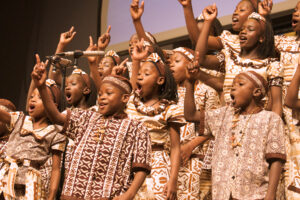
Find an expert. Practice. Research. Learn how to develop a unit featuring seminal pieces of music such as “Lift Every Voice and Sing.”
by Rebecca Fields-Moffitt

A survey in Freedom Songs and a particular focus on the song “Lift Every Voice and Sing.”
Our school district conducts a yearly choral festival, KidSing, for students in 5th and 6th grade. The target audience for this event are students who love to sing, but may not get many opportunities to do so. We are blessed to live and teach in a community with great early arts education opportunities for those who can afford them.
We have Suzuki education, multiple arts-focused pre-school programs, youth theatre programs, youth choirs, etc. We also have a large population that, for a multitude of reasons, cannot access those. We built our festival for them. The festival is a one-day affair at a local performing arts center (this avoids any conflict at our high schools with parking, etc.) that is entirely cost-free for all participants.
Students receive octavos, practice tracks, t-shirts, lunch, snacks, and transportation if necessary. We work with our district foundation to secure the needed funding. We take one student from each 5th and 6th-grade homeroom in the district, giving us approximately 100 singers.
This school year, we needed to change our festival model due to Covid-19 concerns. We chose to highlight one piece for all 5th and 6th-grade students and to offer an opportunity to submit a video to a Virtual Choir as an option. We’ve also teamed up with our Art colleagues, running a project called “Where I’m From” with the opportunity to submit to a Virtual Art Show.
Scour the internet for source recordings or just chat with a colleague. When teaching music that comes from traditions other than our own, we must do our due diligence and learn all we can.
I reached out to a trusted friend and collaborator, Dr. John Wesley Wright, a professor at Salisbury University in Salisbury, Maryland. Dr. Wright has a background in classical voice but has also trained in Singing in the African American Tradition with Dr. Ysaÿe Barnwell of Sweet Honey in the Rock.
If finding a person to connect with and learn from is not possible for you, I recommend Dr. Barnwell’s two-volume series Singing in the African American Tradition. This series’ essential element focuses on aural learning, which is not quite the same as rote learning.
Aural learning is a topic for another article, but suffice it to say that aural traditions carry more weight and history than the process of rote learning implies.
Many western-trained music educators depend on scores to hold pieces for them instead of holding them in their memories. We rely on scores even if we teach our students without them.
The music from the focus tradition does not necessarily rely on a score. The lessons I created include a written score because one of our project’s objectives is to familiarize students with octavos.
However, much of the supplementary music is learned by the teacher and taught without one. Listening and practice are essential before delivering these materials to your students.
For our project, we searched for a score of “Lift Every Voice and Sing” that not only had the target voicing and appropriate difficulty level but sought out an arrangement by a composer with a shared heritage to the piece.
We decided to use a two-part arrangement by Dr. Rollo Dilworth published by Music Xpress. Dr. Dilworth was gracious enough to film a short video for our students to introduce them to the piece.
You never know what can happen until you ask!
When programming and teaching seminal pieces of music such as “Lift Every Voice and Sing,” it is imperative that the teacher knows the piece’s history. This song holds a lot of meaning for generations of Americans, and we need to honor that.
It is not a novelty piece and indeed not a work to be taken lightly. It has led people through many dark times and the hard-history, while not necessarily needing in-depth teaching in the music room, needs to be explored and understood by the teacher giving the lesson.
We wouldn’t teach and perform Bach, Beethoven, and Mozart without due diligence, so we need to do our work here as well. The Video included in the lesson does an excellent job of starting this work, and the book, May We Forever Stand, by Imani Perry, goes very in-depth if your interest is peaked.
I have no pretense that I’ve covered all the important elements of this song. I also claim no expertise in this area beyond what I can research and learn from others. As a white woman, my privilege has granted me much, including not fighting for my place at the table based on my skin color.
The work for gender equality continues, but that is another subject for another time and place. I hope this unit lifts up Black students and provides insight and awareness to students of other races. Black history is American history, and we must celebrate this in our music rooms all months of the year, every year.
Dr. Sarah Fairfield
Diana Hawley
Regenia Bailey
Anthony Hendricks
Dr. Rollo Dilworth
Dr. John Wesley Wright and his students at Salisbury University, Jay Copeland and Annabell Midley
Heidi Goeken and the ICCSD Art Teachers
Evan Hilsabeck and the Coralville Center for the Performing Arts
ICCSD General Music Teachers
Conrad Bendixen
Kate Hagen
Barnwell, Ysaÿe (1998). Singing in the African American Tradition, Homespun.
Barnwell, Ysaÿe (2009). Singing in the African American Tradition-Vol. 2: Building a Vocal Community. Homespun.
Eschelman, D. (2008). Lift Every Voice and Sing [Lesson Plan]. Hal Leonard.
Johnson, James Weldon & Johnson, J. Rosamond (2008). Lift Every Voice and Sing (Rollo Dilworth, arr.) [Musical Score]. Hal Leonard.
Johnson, James Weldon (2019). Lift Every Voice and Sing: A Celebration of the African American National Anthem (Elizabeth Catlett, Illus.). Bloomsbury Children’s Books.
Lyons, Kelly Starling (2019). Sing a Song: How “Lift Every Voice and Sing” Inspired Generations (K. Mallett, Illus.). Nancy Paulsen Books.
Muhammad, L. (July 2, 2020). 15 Powerful Songs That Embody and Support Black Lives Matter Movement. etonline. https://www.etonline.com/15-powerful-songs-that-embody-and-support-black-lives-matter-movement-147773
Perry, Imani (2018). MaWe Forever Stand: A History of the Black National Anthem. The University of North Carolina Press.
Sanger, Kerran L. (1995). “When the Spirit Says Sing!” The Role of Freedom Songs in the Civil Rights Movement. Garland Publishing.

Contributor
Rebecca Fields-Moffitt is currently a General Music teacher in the Iowa City Community School District. She has previously taught secondary Choral Music and General Music in Iowa and Wisconsin and undergraduate courses in General Music and Choral Methods at The University…
Discover more from Rebecca Facebook
 Twitter
 Pinterest
 LinkedIn
 Email
Email Print
Print