SUMMARY
Examine the process of teaching improvisation in this series of articles. Part 2: Learn how the three processes of improvisation.
by Jeremy Howard





Examine the process of teaching improvisation in this series of articles. Part 2: Learn how the three processes of improvisation.
by Jeremy Howard
When compared to language acquisition, improvisation functions in the same manner as independent thought and free speech – an ever-expanding skill that begins in the early stages of musical development. Now we will examine the process of improvisation as it relates to language and music.
Before you log onto your favorite music streaming service to echo every Bobby McFerrin album, let’s break down the components of improvisation. Just as reading music has several layers happening at once (vertical reading for pitch, horizontal reading for rhythm), so does improvisation:
Timing is the most basic aspect of improvisation. Students must learn when to respond and develop independence. Call & response style is the first step towards timing. They must be able to hear and feel a completed phrase – the question – and prepare their breath to respond with an answer.

The first step in practicing timing is to provide songs and chants where the answer is the same each time. Look for repertoire with literal questions and answers.
What are some other Q & A songs you can think of where the response is always the same?

Again, there is no choice. Students simply read the recipe and fill in the blank. With each repetition, we can supply a different recipe. Additionally, we can choose to show the recipe at the beginning of the song, or for an added challenge, at the beginning of the final phrase.
Find songs that allow for natural improvisation and creativity, allowing for word changes. Improvising is the norm for much of American folk repertoire – that’s why we have so many variations of the same song.
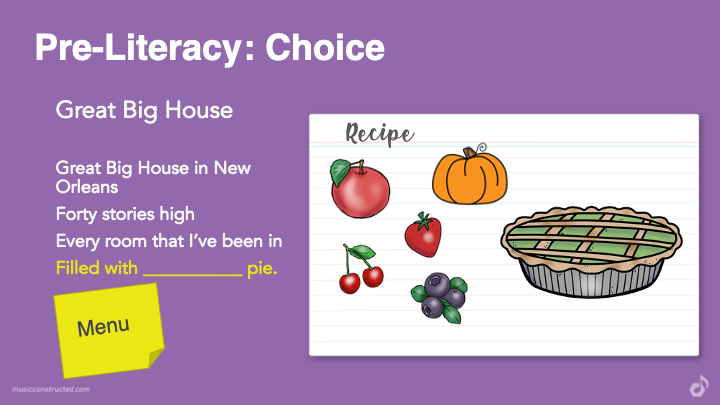
Notice that as we add choices, students may struggle with timing. Begin with two options and expand as your students are able. Encourage students to look over the choices on the recipe card while singing the song.
Are there other “fill-in-the-blank” type songs that we can use for this component?
Students choose and respond within the teacher’s pre-set guidelines (category, rhythm set/tone set, empty beats, empty staff). With no visuals to choose from, the difficulty level increases as timing and choice are still in play. Instead, students must visualize the options from a predetermined category.

In this example, students must think of a response from the category, “vegetables.”

The song, Categories, offers a fast-paced variation. Students sit in a circle and respond with their choice on time from a selected framework (category). You can vary the amount of time between each response by changing the number of handclaps to suit your students’ needs.
In Part 1: Learning the Language of Music we compared the acquisition of music and language. Part 2: The Process of Improvisation we used the Three-Step Process (Timing, Choice, Framework) for improvising words only. Part 3: Warming Up with Pre-Literacy will examine and apply this process to other forms of improvisation.
Part 1: Learning the Language of Music
Part 2: The Process of Improvisation
Part 3: Warming Up with Pre-Literacy Improvisation
Part 4: Pre-Literacy Improvisation in Songs and Stories
Part 5: Pre-Rhythm and Pre-Melodic Improvisation
Part 6: Question and Answer Improvisation
Part 7: Rhythm and Melody Improvisation Games
Part 8: Putting the Puzzle Together

Contributor
Jeremy Howard received a BME in vocal music education and an MM with an emphasis in the Kodály philosophy from Morehead State University and is a certified Kodály educator. Additionally, he studied at the Kodály Institute in Kecskemet, Hungary. Mr. Howard serves as the 3 Year-Old through 8th Grade…
Discover more from Jeremy